
As cyber threats become more sophisticated, organisations are under increasing pressure to strengthen their security operations. One of the biggest strategic decisions businesses face is whether to build an in-house Security Operations Centre (SOC) or partner with an external provider for Managed Detection and Response (MDR).
Both approaches aim to achieve the same goal, continuous threat detection and rapid response, but the path, cost, and complexity differ significantly.
What Is a SOC?
A Security Operations Centre (SOC) is an internal team and infrastructure dedicated to:
- Monitoring systems and networks
- Detecting threats and anomalies
- Investigating incidents
- Responding to cyberattacks in real time
A fully functioning SOC typically operates 24/7, using a combination of tools, processes, and skilled analysts.
What Is MDR?
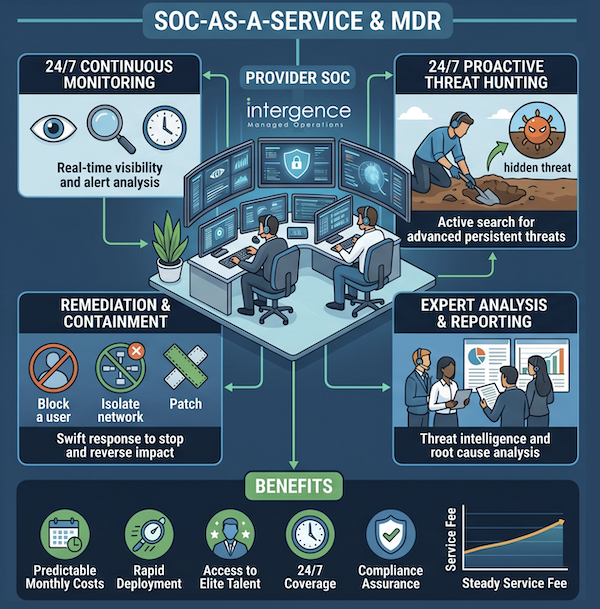
Managed Detection and Response (MDR) is an outsourced service that delivers many of the same capabilities as a SOC, but through a third-party provider.
MDR services:
- Monitor your environment continuously
- Detect and investigate threats
- Respond to incidents on your behalf
- Provide access to global threat intelligence and expertise
Providers like Sophos combine advanced technology with dedicated security teams to deliver this as a service.
Building Your Own SOC: The Reality
On paper, an in-house SOC offers maximum control. In practice, it comes with significant challenges.
1. High Cost of Ownership
Building a SOC requires:
- Security tools (SIEM, EDR, threat intelligence platforms)
- Infrastructure and storage
- A team of skilled analysts across multiple levels
Costs can quickly exceed £1–2 million, even for smaller organisations.
2. Staffing Challenges
A 24/7 SOC requires:
- Multiple shifts of analysts
- Senior specialists for escalation
- Ongoing training and certification
Cybersecurity talent is:
- Expensive
- Difficult to recruit
- Hard to retain
Without the right people, even the best tools are ineffective.
3. Time to Deploy
Standing up a SOC is not quick:
- Hiring alone can take months
- Tool selection and integration is complex
- Full operational maturity can take 6–12 months or more
During this time, organisations remain exposed.
4. Operational Burden
Running a SOC involves:
- Continuous monitoring and alert management
- Regular updates and tuning
- Managing false positives
- Maintaining compliance and reporting
This creates a significant ongoing workload for internal teams.
Outsourced MDR: A Practical Alternative
MDR has emerged as a popular alternative for organisations that need strong protection without building everything themselves.
1. Immediate 24/7 Coverage
MDR services are:
- Fully operational from day one
- Staffed by global teams working around the clock
This eliminates the gap between business hours and attacker activity.
2. Lower and Predictable Costs
Instead of large capital investment, MDR offers:
- Subscription-based pricing
- No need to hire or retain a full security team
- Reduced infrastructure costs
This makes enterprise-grade security accessible to more organisations.
3. Faster Detection and Response
MDR providers focus on:
- Rapid threat identification
- Investigation within minutes
- Immediate containment and remediation
In many cases, incidents are resolved before internal teams are even aware.
4. Access to Expertise and Intelligence
MDR gives organisations access to:
- Highly skilled analysts
- Global threat intelligence
- Continuous improvements based on real-world attacks
This level of expertise is difficult to replicate internally.
The Trade-Offs
While MDR offers clear advantages, it’s not without considerations:
- Less direct control over operations
- Dependence on a third-party provider
- Potential for more standardised (less tailored) approaches
That said, many modern MDR services are highly configurable and work closely with internal teams.
SOC vs MDR: Which Should You Choose?
The right choice depends on your organisation’s size, risk profile, and resources.
Choose an in-house SOC if:
- You have significant budget and scale
- You require full control and customisation
- You can recruit and retain a dedicated security team
Choose MDR if:
- You need fast, effective protection
- You want 24/7 coverage without building a team
- You are looking for a cost-effective, scalable solution
A Hybrid Approach?
Some organisations adopt a hybrid model, combining:
- Internal oversight and governance
- External MDR for monitoring and response
This can offer the best of both worlds, control with capability.
Final Thought
Cybersecurity is no longer optional, and the speed of modern threats means that detection and response must be immediate and continuous.
For most organisations, building a SOC from scratch is complex, costly, and slow. MDR provides a practical way to achieve the same outcomes at a fraction of hte cost.
The key is not just choosing a model, but ensuring that whatever approach you take delivers:
- 24/7 visibility
- Rapid response
- Ongoing resilience
Because in today’s threat landscape, it’s not just about having security, it’s about having security that actually works when it matters most.
Want to read more about the top reasons to use Managed Detection and Response? Read Sophos' white paper here.